


Elle and her story about courage, motherhood and no regrets
For Breast Cancer Awareness Month, mum of three Elle shares her story: a preventive double mastectomy, the guilt that followed her into motherhood, and why no mum should be made to feel bad about how she feeds her baby.

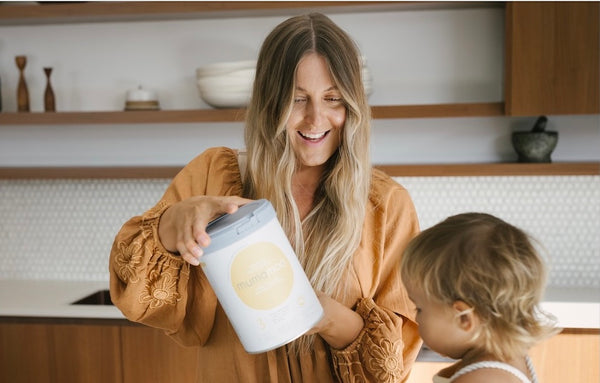
This October, for Breast Cancer Awareness Month, we're sharing a story from one of our mumamoo mums. Elle is a mum of three. Two years before her first pregnancy, she chose to have a preventive double mastectomy. This is her story, in her words, about that decision, about the guilt that followed her into motherhood, and about feeding her babies without fear.
When Elle reached out to us, she didn't hold back. "I'm a pretty open book," she told us. "If it can help just one person feel like they've done the right thing, that would feel amazing for me."
A decision made for the future
Elle carries a BRCA gene variant, which significantly raises the risk of breast cancer. At the time, she was single. She had always planned to have children one day, but motherhood still felt a long way off.
The decision to have both breasts removed came down to someone she loved. "I actually lost a friend to bowel cancer," she says. "He was the reason I was like, no, I'm going ahead and doing this, because I don't want that risk for myself."
She was thinking about a future family she hadn't yet met. "I didn't want to get to a position where I had a family and risk something happening to me, and them losing me."
It wasn't an easy choice. "That was something that really hurt my confidence," she says, "and me, feeling like a woman."
Elle met her partner after she had made the decision to go through with surgery. They married and started a family sooner than she'd ever imagined. Today their children are two and a half, one and a half, and six months old.
After a double mastectomy, breastfeeding isn't possible. "I physically cannot," Elle explains. "I do not produce milk. All my ducts are gone."
Yet in hospital, after the birth of her first baby and with most of the others too, she was made to feel she had to justify herself. "The nurses in the hospital gave me a hard time because I was choosing not to breastfeed," she says, "without realising that it wasn't my actual choice."
That first time was the hardest. "I didn't have the greatest birth experience," Elle says. She laboured alone in a room in emergency, going from 0 to 9.5 centimetres dilated without any pain relief. "I was so scared. I was a first-time mum, I was so lost." After the birth, her placenta had to be surgically removed.
So when she felt judged against the "breast is best" message, it cut deep. "I was left questioning whether I made the right choice, and asking, did I take something away that my kids needed?" she says. "It's hard enough adjusting to a new baby and recovering from birth, but to have that added was a lot."
In those early weeks with her daughter, Elle was overwhelmed by doubt. "I did become filled with doubt and guilt and questions about, did I do the right thing?" she says. "Is she going to get what she needs? Should I have waited to do the surgery?"
The decision she'd made to protect herself suddenly felt tangled up with her children. "While I was protecting myself, have I done the right thing for my children? Are they going to get what they need?"
Feeding brought its own challenges. With her first two babies, finding a formula that suited them took a lot of trial and error. By the time her third came along, she felt more settled, and more sure of herself as a mum.
No guilt, no shame, no stigma
Today, Elle wants other mums to hear what she needed to hear back then. Whatever your reasons for formula feeding, you have made the right decision.
"They've made the right decision, regardless of what that looks like to other people," she says. "And you shouldn't be made to feel bad about that."
She's also thinking of the many mums whose stories look different from hers. Some have been diagnosed with breast cancer and are going through treatment while raising young children. For them, and for every mum feeding her baby the way that works for her family, Elle's message is the same: Feed Fearlessly.
Thank you, Elle, for trusting us with your story.
Breast Cancer Awareness Month: where to start
Breast Cancer Awareness Month runs from 1 to 31 October. If Elle's story has you thinking about your own health, here's where to begin.
-
BreastScreen Australia: Offers free screening mammograms every two years for women aged 50 to 74, with eligible access starting at 40 or continuing past 75. You can book through BreastScreen Australia or your local state provider, such as BreastScreen NSW or BreastScreen WA. Learn more at Cancer Australia.
-
Breast awareness: Get to know the normal look and feel of your breasts during everyday activities like showering or dressing. Look out for changes such as new lumps, skin dimpling, nipple discharge or unusual pain, and see your GP promptly. Know what's normal for you.
If you have a family history of breast or ovarian cancer, talk to your GP about whether genetic testing or counselling is right for you.